


An Insight into the World of Coffee Processing
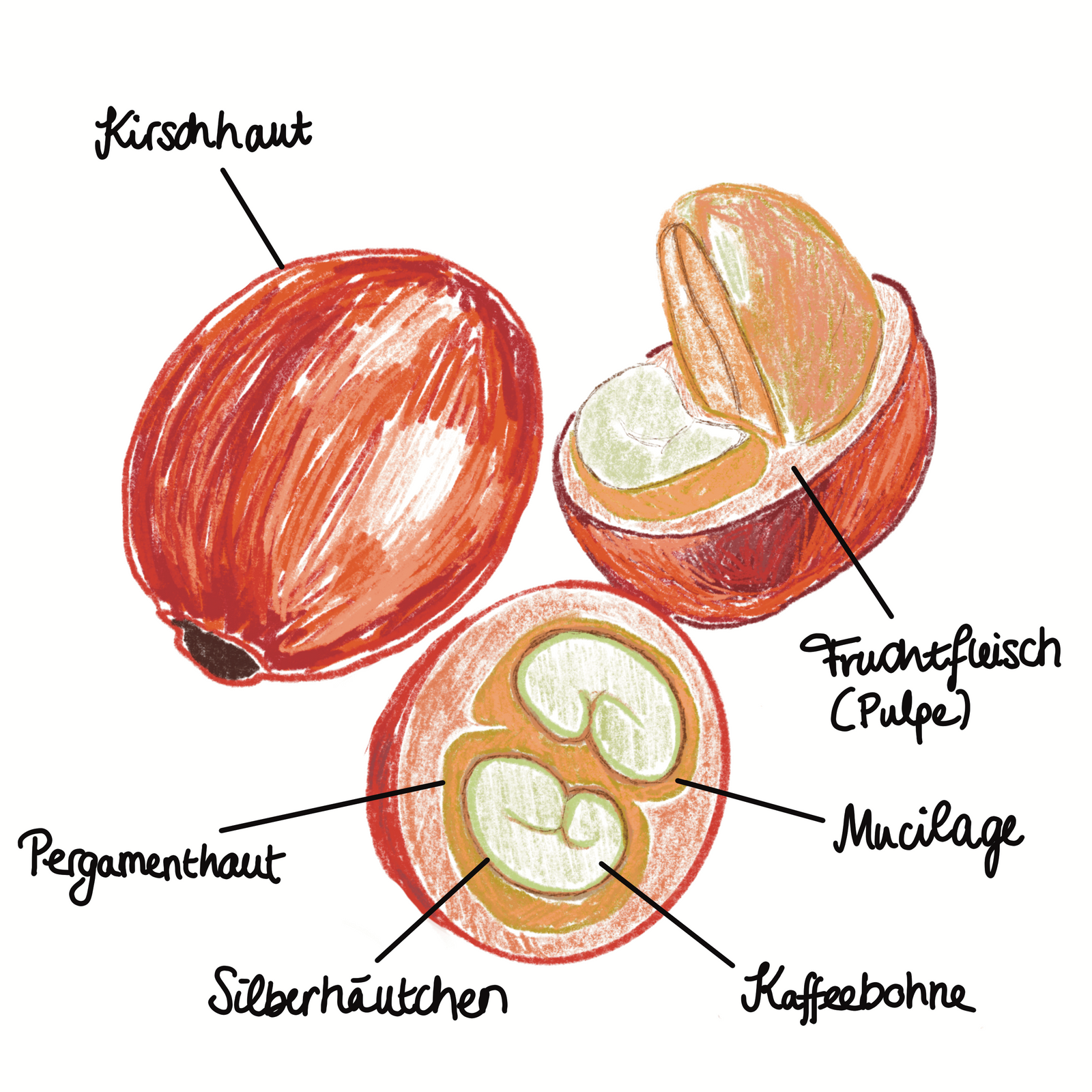
Processing methods are used in coffee-producing countries to separate the pulp from the bean of the coffee cherries. The exact way this is done affects the flavor profile of our coffee. Characteristic aromas can be identified depending on the method, and you can choose for or against a particular processing method according to your taste. For instance, wet-processed coffee often has a bit more acidity, while dry-processed coffee usually brings a certain sweetness and berry notes. You will now learn exactly what processing entails, what role it plays in coffee production, and how the individual processing methods differ.
This text can serve as a guide to help you navigate the jungle of different, often overlapping, methods.
Initially, it is particularly important to process the coffee cherries within a few hours of harvesting. Due to their high water and sugar content, fermentation processes can quickly begin, potentially spoiling the entire harvest if not done quickly enough. Only ripe cherries should be processed; otherwise, unripe cherries will release unripe acids and few other aromas. The taste of overripe cherries transfers to the other beans, resulting in a rotten aroma that cannot be removed from the beans.
The ripening times of cherries on a plantation vary widely, sometimes up to three months. To ensure that only equally ripe cherries are harvested, hand-picking ("selective picking") is the best method. This elaborate and time-consuming method is mostly used for specialty coffee. For mass production, producers often wait until most of the cherries are ripe, which are then usually harvested by machine. Often, no sorting of the cherries takes place afterward. Coffee for the specialty sector, however, is sometimes sorted multiple times at different points in the processing.
The bean must eventually be freed from the surrounding pulp as quickly as possible. This is where the various processing methods come in, each with its own advantages and disadvantages. Each method imparts a characteristic flavor profile to the coffee beans, which can be created with more or less control.
However, farmers in coffee-producing countries do not always have the choice to opt for or against a specific processing method. Very often, factors such as climate or financial resources play a major role in determining which method is used. Better-resourced farms, for example, with greater financial means, have more opportunities to invest in things like cooling.
Coffee is and remains a natural product, and all farms deal with this equally. The processes I describe here are mature, plannable, and for specialty coffee in particular, require precise execution. Certain aspects, such as weather, sugar content, or defects in individual beans, are never entirely predictable. This is the beauty and excitement of coffee; you never know 100% what to expect when the samples, i.e., the coffee samples, arrive. You should always adjust your roasting process and everything that follows accordingly.
Dry Processing | The Natural Method
Dry processing is the oldest method used to separate the pulp from the coffee bean. After harvesting and manual sorting of unripe fruits, the beans are spread out over a large area in the sun. This can happen on large drying tables ("raised African beds") or on stone surfaces ("drying patios"). On the tables, ventilation from below ensures more even drying. It is important to turn the beans repeatedly to prevent mold. The moisture content of the beans should ultimately be 10-12%. The storage period for green coffee is at least four weeks. Afterward, the shriveled pulp, the pectin layer, and the parchment skin of the beans are mechanically removed through what is known as "hulling," before the beans are finally sorted by color and size and packaged.
Opportunities:
- Resource-saving method: Little to no water needed, little technical equipment required.
- More environmentally sustainable than other methods: Produces few waste products, soil fertility is maintained.
- Slow and even sun drying can positively influence the quality and shelf life of green coffee. Beans are made more durable.
Risks:
- Long drying time: High labor costs. Especially in the specialty coffee sector, as the most even drying possible is required. Duration can affect production capacity.
- Difficult to control process: Rotting, mold formation, and over-fermentation can spoil an entire harvest. Loss of aroma if dried too quickly.
- Weather dependency: Consistent taste across different harvests is difficult to achieve.
Characteristics:
Dried fruit, fruity-sweet, blueberry, cherry, plum, nougat, tropical fruits, strawberry, floral, flowery notes, full body.
Typical Origin Countries:
Countries with little water and low humidity, e.g., Ethiopia, Uganda, or Brazil.
Wet Processing | Washed Coffee | Fully Washed
First, after harvesting, the cherries are transported to a water tank before fermentation can begin. This should happen approximately eight hours after harvest. Due to fruit swelling, ripe cherries separate from unripe ones, as ripe cherries sink to the bottom of the tank. Before drying, most of the pulp and the outer skin are removed from the coffee bean. A depulper is used for this purpose. The depulper is a machine that removes the pulp from the coffee bean through crushing and friction, using water. The pectin layer and silverskin remain on the bean. Then the cherries go into a water tank, where the remaining pulp begins to ferment and thus detaches from the beans. Finally, the beans are dried by turning them in the sun. The beans should be brought to a moisture content of 10-12%.
In the specialty coffee sector, another step is often added, in which good beans are sorted from bad ones, for example, those with insect damage, color defects, stones, or other extraneous matter.
Opportunities:
- More consistent quality: Fewer undesirable drying effects due to prior natural sorting of bad cherries in the water tank.
- Process predictability and verifiability: Fermentation duration determines taste. Defects and off-flavors can be prevented more easily, and unwanted fermentation processes are reduced by thorough cleaning.
- More stable end results: Process is well controllable. A more consistent and predictable coffee quality is achieved. Risk of microbial spoilage is reduced.
- Hygienic processing through washing process.
Risks:
- Resource-intensive method: A lot of water is needed, which can negatively impact the water cycle in the origin countries.
- Environmentally challenging method: Contaminated water often enters the environment. Soil erosion is promoted. The energy required to operate the machinery is high.
- Higher production costs due to specialized equipment.
- Higher labor costs overall due to different work steps.
Characteristics:
High acidity, high complexity, clear, tea-like, peach, citrus, jasmine.
Typical Origin Countries: Kenya, now Ethiopia.
Hybrid Method | Pulped Natural
During this method, less water is used than in wet processing. As with wet processing, ripe beans are separated from unripe ones in the water tank. Then, the skin and almost all of the pulp are mechanically removed, with only a small amount remaining randomly on the beans. These are then spread out on drying areas. Because there is as little pulp as possible on the beans, the risk of defects is significantly reduced, and fermentation is almost non-existent. This method is very similar to the Honey Processing method, which first originated in Costa Rica, while the Pulped Natural method first appeared in Brazil. The biggest difference between the two methods lies in the amount of pulp that remains on the bean.
Opportunities:
- Lower water consumption than the fully-washed method.
- Accelerated drying process: Uncontrolled fermentation and mold formation occur less frequently than with purely dry-processed coffees.
- Less technical equipment needed than with other methods.
- Geographically flexible: This method works well in various altitudes with different environmental conditions.
Risks:
- Difficult to control how much pulp remains on the bean: The more pulp on the bean, the more likely fermentation effects and over-fermentation.
- Cost and labor-intensive method.
- Weather dependence during the drying process.
Characteristics:
Sweet and full-bodied, yet clear. Nut, chocolate, cherry, dried fruits, less acidity than washed coffees, mild.
Typical Origin Countries:
Brazil.
Hybrid Method | Honey Processing | white, yellow, red, black
First, the beans undergo mechanical depulping with very little water. A certain percentage of the pulp is intentionally left on the bean, in varying thicknesses. This layer is called mucilage and resembles honey when dried, hence the name. The layer remains on the bean during drying. Depending on how much mucilage remains on the bean and the associated drying time, distinctions are made between White Honey (10-20% remains on the bean), Yellow Honey (20-30% remains on the bean, both dry for about two weeks), Red Honey (30-40% remains on the bean, dries for about two to three weeks, sometimes covered) or Black Honey (50-70% remains on the bean, not dried in direct sunlight, sometimes covered to prolong the process).
Opportunities:
- Accelerated drying process: Uncontrolled fermentation occurs less frequently than with pure naturals. Less susceptible to spoilage.
- Partial predictability of the process: The amount of pulp remaining on the bean is controllable and leads to corresponding aromatic results.
- Geographically flexible: This method works well in various altitudes with different environmental conditions.
Risks:
- The more pulp remains on the bean, the more likely fermentation effects and over-fermentation occur: Increased risk of off-flavors or masking of aromas.
- Flavor consistency during drying and due to weather conditions is more difficult to achieve than with fully washed coffees.
- Labor-intensive method.
Characteristics:
White Honeys: Clarity of washed coffees; Yellow Honeys: Fruity notes; Red Honeys: Less acidity, fruity; Black Honeys: Dark fruits, chocolaty.
Typical Origin Countries:
Costa Rica, El Salvador.
Hybrid Method | Semi-Washed Processing | Semi-washed
The beans are depulped and washed to remove the outer layers, while the parchment skin remains. In the wet-hulled method, more pulp remains on the beans before they are laid out to dry. After washing, the beans are not fully dried, but only brought to a moisture content of 30-35%. The exact moisture content varies according to the producer's preference. Afterward, the parchment skin is removed, and the beans are dried a second time until there is no longer a risk of spoilage.
Opportunities:
- Reduced risk of spoilage.
- Well-controllable process.
- Well-suited for regions with humid climatic conditions.
- Less time-consuming.
Risks:
- Dependence on environmental factors such as humidity and temperature.
- Susceptibility to mold, rot and defects due to semi-humid conditions.
Characteristics:
The early removal of the parchment skin creates a typical flavor. Less acidity, more body, spicy, woody, tobacco, leather, earthy, full body, light sweetness.
Typical countries of origin:
Indonesia, Brazil.
Mixing process | Double washed
The coffee beans are washed twice to remove as much of the pulp and residue as possible. The first wash takes place immediately after pulping. Sometimes the beans are temporarily stored and dried between the two washes. During fermentation in the water tank, which is calculated and limited differently in time, the beans are washed a second time so that they are cleaned as completely as possible of the mucilage. The beans then dry flat in the sun. Finally, the beans are stored in sacks for about two months and the parchment skin is removed at the very end, before the final sorting.
Opportunities:
- Control over the fermentation process: uniform fermentation and drying as well as reduction of undesirable aromas are well possible.
- Consistently good quality achievable due to high cleanliness of the beans.
Risks:
- Time-consuming.
- Complex method, therefore prone to errors.
- Risk of over-fermentation if the beans remain in the water for too long.
- High water and energy consumption.
- Risk of over-processing the beans, whereby they can lose aromas if too much water is used.
Characteristics:
Clear, balanced, clean taste, citrus, grapefruit, berry, stone fruit, peach, tropical fruits.
Typical countries of origin:
Kenya, Rwanda, Colombia, Costa Rica.
Mixing process | anaerobic
First, the coffee beans are pulped and transferred to fermentation tanks; sometimes whole coffee cherries are also added. Oxygen is removed for almost 24 hours, and the pulp residues are sometimes added afterwards. In another variation of this process, the whole coffee cherries are placed in the tanks and then fermentation takes place. The fermentation process is controlled and can vary depending on the desired effect.
Opportunities:
- Upgrading of inferior coffee possible through extreme fermentation.
- Fermentation process easily controllable: great influence of producers on factors such as sugar content during fermentation.
- More sustainable form of coffee bean processing, generates less waste.
- Experiments possible: Producers have the opportunity to change the fermentation process through temperature and duration and to develop new flavor profiles.
Risks:
- Extreme fermentation can mask delicate aromas.
- Complex process: expert knowledge required, especially great care necessary during harvesting, as only ripe, sugar-rich cherries are needed for fermentation, high risk of production errors.
- High equipment costs.
- Susceptibility to contamination during fermentation.
Characteristics:
Acidic, soft mouthfeel, fruitiness, stone fruits, berries, caramel-like, honey, jasmine, lavender.
Typical countries of origin:
Costa Rica, El Salvador, Brazil, Colombia, Ethiopia
Mixing process | Carbonic Maceration
This is a process originally used in the wine industry. After sorting out unripe and defective coffee cherries, a controlled fermentation of the whole coffee cherries takes place in fermentation tanks that are filled with carbon dioxide and sealed. Carbon dioxide is then added. Oxygen escapes and sugars and pectins are produced. This fermentation process can take hours to weeks. The temperature must be checked repeatedly to ensure that the fermentation proceeds as it should. At the end, the coffee beans are dried in the sun. In the washed carbonic maceration process, the pulp is separated from the bean beforehand and then placed in the tank.
Opportunities:
- Controllable and manageable fermentation process.
- Development of new flavor profiles possible: Different variations of the process can be tried out.
- Differentiation in the coffee market through a new and unusual method for coffee producers.
Risks:
- Complex and elaborate process: precise control of environmental conditions necessary.
- High risk of production errors.
- Risk of contamination: for example, due to unclean work with the equipment.
- High equipment costs.
- Long fermentation times.
Characteristics:
Red wine, cherry, banana, pineapple, papaya, fruity, floral, complex, spicy.
Typical countries of origin:
Costa Rica, El Salvador, Brazil, Colombia, Kenya.
Mixing process | Monsooning from Malabar
First, the coffee beans are washed to clean them. After drying in the sun, the coffee beans are exposed to monsooning in a 10-15 cm thick layer by storing them in special warehouses with open windows in the humid monsoon air from June to September. Due to the high humidity, the beans ferment in the warehouses, and the beans are turned repeatedly. Finally, the coffee beans dry in the sun, after which they are sorted.
Opportunities:
- Longer shelf life without loss of quality.
Risks:
- Beans are brittle, making even roasting difficult.
- Uncontrolled process, as it is very weather-dependent.
- High risk of mold formation and loss of aroma.
- High labor input.
Characteristics:
Mild, low acidity, dusty, licorice, coriander, sharp taste, earthy, wood.
Typical countries of origin: India, Malabar region.
The Kaffeekommune and many other cafés and roasteries that process specialty coffee have a great wealth of knowledge about the origin of their coffee and strive to offer their guests the best quality. Processing specialty coffee is special because it involves precise work and is based on certain principles. It's about aromatic diversity, preserving the origin, and getting as much as possible out of the green coffee without destroying or disproportionately highlighting terrain-specific nuances.
The processing methods are deliberately chosen to achieve certain flavor profiles. Experiments can play a role, for example, in the Carbonic Maceration process. However, it is also about achieving consistently excellent quality.
In the global market, specialty coffee currently accounts for only about 10%. Therefore, only a small fraction of farms produce their coffee in a way that might be interesting for specialty coffee enthusiasts. For farmers, producing specialty coffee often means changing their way of working and their equipment. It is about controlling the green coffee differently and should pay off for the people at the origin.
We want to continuously develop and serve our guests coffee they have never tasted before. You will find exactly that at the Kaffeekommune.


Leave a comment